How Tier-2 D2C Brands Compete with Unicorns Using Kyde Funnels
Harsh
Digital Triangle
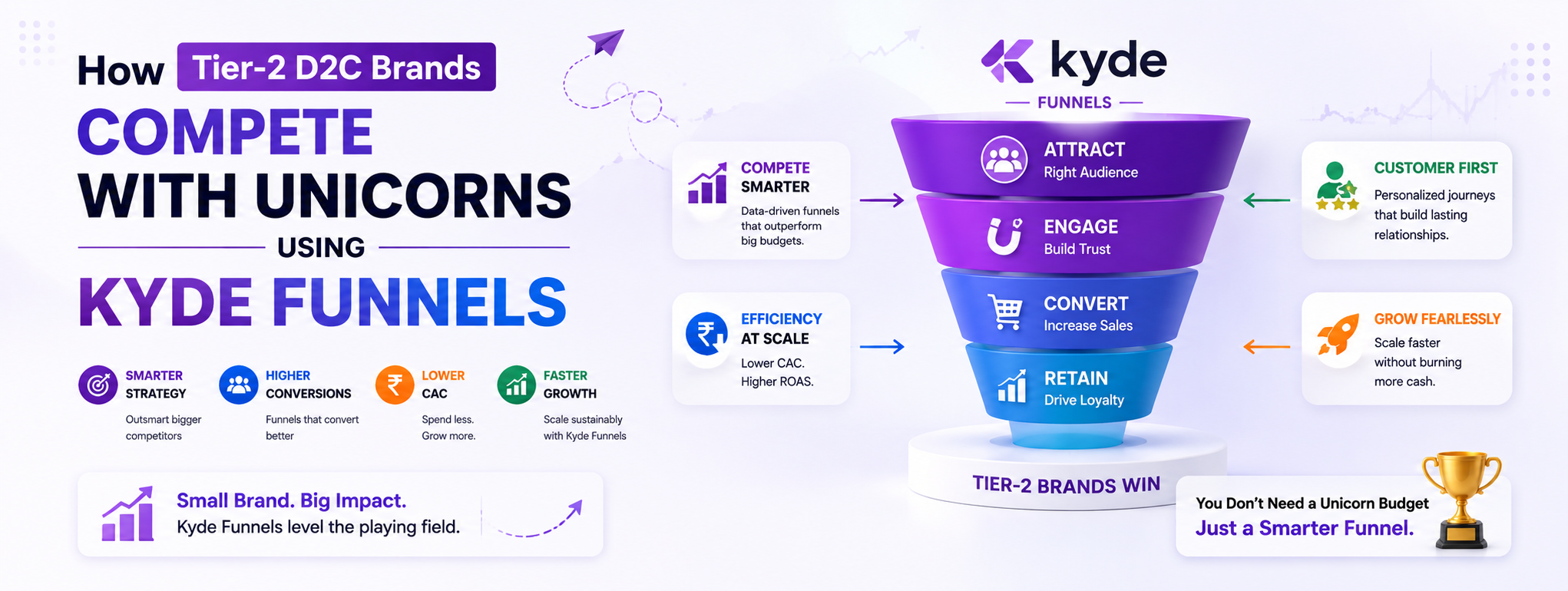
The Indian Direct-to-Consumer (D2C) story is often framed by the successes of mega-brands—the unicorns with war chests for marketing. Their names dominate the metropolitan landscape, fueled by massive VC funding and celebrity endorsements. But behind the headline figures, a silent, more profitable revolution is underway.
The real growth engine for India’s digital economy isn’t the Tier-1 metros; it’s the Tier-2 and Tier-3 D2C brands who are scaling not with endless ad spend, but with leaner, smarter, and more personalized conversational funnels. These agile brands are sidestepping the high Customer Acquisition Cost (CAC) trap by moving their entire commerce experience to the customer’s preferred channel: WhatsApp.
Kyde WhatsApp API and RCS automation platform. Kyde transforms a cold ad click into a warm, automated conversation, turning transactional customers into loyal, repeat buyers. This comprehensive guide is the playbook for every D2C founder looking to build a sustainable, retention-first business that can compete with unicorns on the strength of its customer relationship, not its balance sheet.
The D2C Landscape in India: The Tier-2/3 Opportunity
India’s D2C market is projected to reach over $267 billion by 2030 with a blistering 25% CAGR, yet the core of this growth is shifting dramatically. While established brands battle for screen space in Mumbai and Delhi, the true volume and velocity are emerging from the smaller cities and towns.
The Dynamics of India’s D2C Ecosystem
The Scale of the Underdog: India boasts over 800+ D2C brands, and a significant 70% of them operate in the Tier-2, Tier-3, and vernacular-speaking regions. Smartphone penetration in these areas hit 78% in 2024, creating over 150 million new digital consumers.
The Unicorn’s Blind Spot: Legacy D2C unicorns often rely on a metropolitan, English-first, credit-card-dominant model. This creates an enormous gap in the market, as orders from small towns already exceed 50% of GMV on major e-commerce platforms.
The Core Challenges for Tier-2 Brands:
Limited Budget: Ad spend is tight; there’s zero tolerance for wasted impressions.
High CAC: With CPC/CPM rising across Meta and Google, the cost of acquiring a customer who may not buy again is prohibitive.
Lack of Funnel Automation: Over-reliance on manual processes or generic email/SMS for post-purchase communication limits scale and personalization.
The Conversational Opportunity
The key to unlocking the Tier-2/3 market is trust and convenience. In these regions, the messaging inbox (specifically WhatsApp) is the primary digital gateway. With over 500 million WhatsApp users in India, it boasts open rates exceeding 90%—a figure email can only dream of (which averages around 20%). Kyde is built to capitalize on this WhatsApp-first consumer behaviour, creating direct, trust-based connections that are inherently more profitable.
Where Tier-2 D2C Brands Lose Money (The Leakage Points)
Before building a Kyde-powered funnel, a Tier-2 brand must surgically identify and plug the three major money-leaks that plague the conventional D2C model.
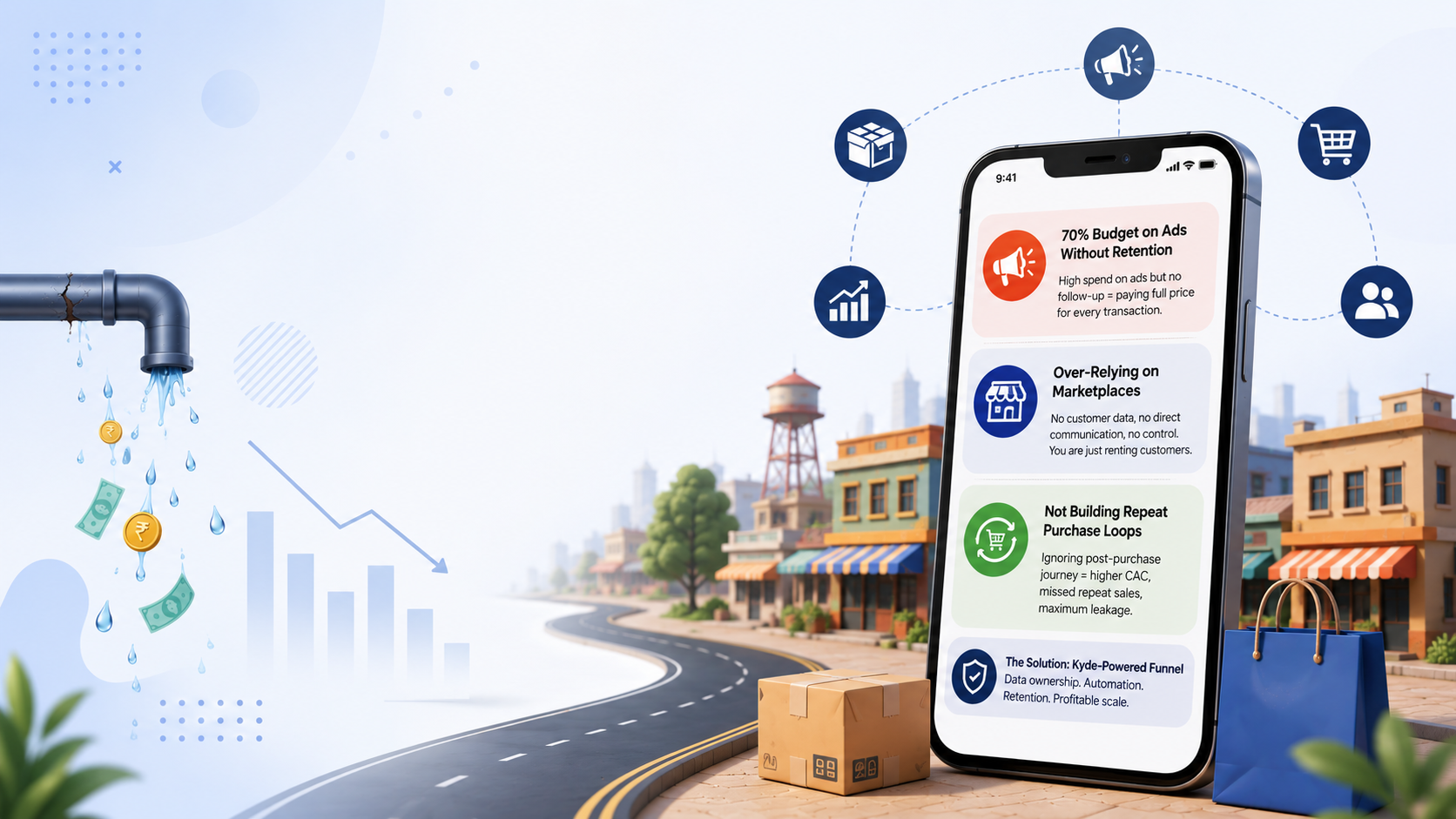
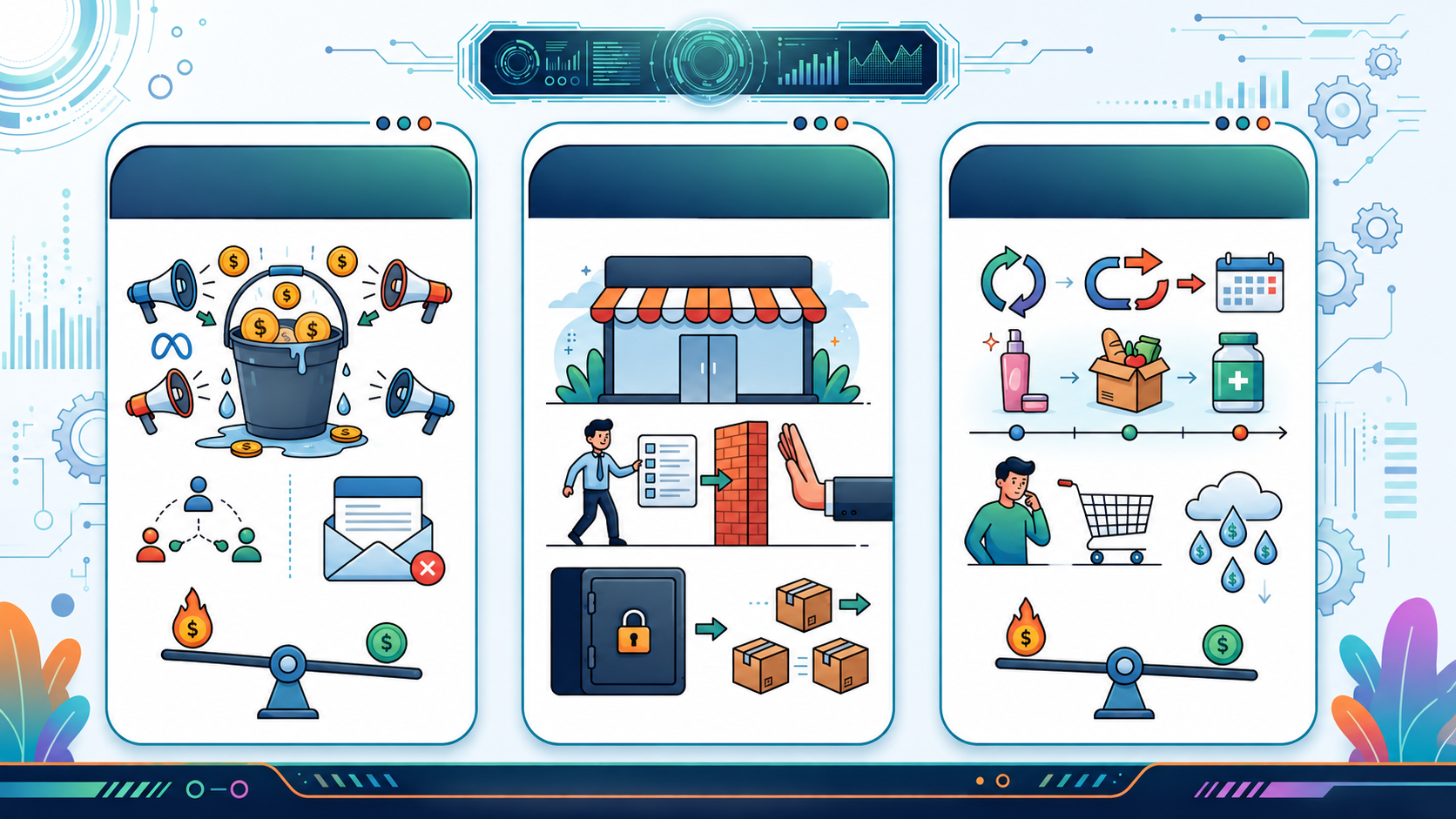
Spending 70% Budget on Ads Without Retention: The most common mistake is a transactional mindset. Brands spend heavily on Meta/Google for a first sale, but the follow-up is poor (generic email or SMS). They are paying full price for every single transaction instead of nurturing the customer into a repeat buyer, where acquisition cost is zero.
Over-Relying on Marketplaces (Amazon/Flipkart): While marketplaces offer reach, they offer no customer data. This means no direct communication, no custom retargeting, and no control over the post-purchase experience. You are perpetually renting your customers.
Not Building Repeat Purchase Loops: The cost of acquiring a new customer is up to 5 times higher than retaining an existing one. Ignoring the post-purchase phase, particularly for products with a defined replenishment cycle (e.g., cosmetics, groceries, health supplements), is the fastest way to bleed capital. Retention is the new CAC.
The solution is an integrated, conversational funnel that prioritizes data ownership and repeat purchase automation using Kyde.
The D2C Growth Stack: Awareness to Retention with Kyde
The high-growth blueprint for Tier-2 D2C brands requires a lean but powerful technology stack, with Kyde acting as the central Conversion and Retention Engine. This is how a limited budget is leveraged into maximum Customer Lifetime Value (CLV).
Funnel Entry: Awareness via Lean Ads
The goal here is not mass awareness, but qualified traffic. Ads should be cost-efficient and focused on driving users to a conversational entry point, not a complex website checkout.
Meta for Discovery: Use Instagram Reels, high-impact Carousels, and engaging short-form video to build immediate connection and trust. Creatives must be cost-efficient and authentic, often leveraging User-Generated Content (UGC) styles rather than glossy, expensive studio productions.
Google for High-Intent Searches: Invest budget in branded search and specific long-tail keywords. This targets users who are actively searching for the product and have the highest purchase intent.
The Conversational CTA: Every top-of-funnel ad must feature a Click-to-WhatsApp or Click-to-RCS call-to-action, immediately pushing the user into the Kyde funnel, where the real work of conversion begins.
Funnel Middle: Conversion via Kyde Automation
This is where the Tier-2 brand’s agility triumphs over the unicorn’s inertia. Kyde enables conversational commerce—making the path to purchase instantaneous, personal, and frictionless, all within the chat interface.
WhatsApp Welcome Flows: When a user clicks the ad, Kyde automatically initiates a welcome flow. This isn’t a generic reply; it’s a personalized message using the user’s name and potentially even the vernacular language based on Geo-data. The flow immediately offers a personalized incentive (e.g., “Welcome! Here is a 10% discount on your first order. Are you interested in Skincare (Reply 1) or Haircare (Reply 2)?”). This micro-segmentation qualifies the lead instantly.
RCS Campaigns: Rich Visuals and CTAs: For broader, high-impact campaigns (like new product launches or festive sales), Kyde leverages Rich Communication Services (RCS). RCS supports richer visuals, carousels, and interactive buttons directly within the Android default messaging app, leading to 4x higher engagement vs. SMS. This is perfect for showcasing product collections outside of the website.
Catalog + Payments Inside Chat: Kyde integrates the Product Catalog and UPI-based payments directly into the chat flow. The customer can browse products, get instant answers via a pre-trained chatbot, and complete the transaction without ever leaving the WhatsApp window. This “Headless Checkout” process dramatically shortens the purchase journey and slashes the checkout drop-off rate.
Tier-2 Cosmetic Brand Example: A small cosmetic D2C brand in Punjab ran a ₹20K Meta ad campaign, driving all leads to a Kyde WhatsApp flow. The flow offered a vernacular welcome and a personalized product recommendation based on a 3-question quiz. Result: The brand achieved a 22% conversion boost compared to its previous website-only funnel, demonstrating that a small budget can yield huge returns when paired with smart funnel tech.
Funnel End: Retention via Kyde Automation (The Repeat Loop)
The true measure of a D2C champion is its ability to foster repeat purchases. Kyde automation turns the one-time buyer into a high-CLV customer.
Automated Abandoned Cart Recovery: This is the lowest-hanging fruit. Instead of a forgotten email, Kyde sends an automated WhatsApp cart recovery flow within 30-60 minutes, using rich media and a direct payment link in the chat.
Apparel D2C Example: An apparel brand recovered 18% of abandoned carts using Kyde’s automated, timely WhatsApp nudge—a conversion rate that is virtually impossible with email.
Vernacular Broadcasts and Hyper-Personalization: Kyde enables personalized broadcasts in Hindi, Tamil, Marathi, or any regional language. This caters directly to the Tier-2/3 audience, building immense loyalty. These broadcasts are used for:
Loyalty Rewards: Delivering birthday discounts or early access codes directly via WhatsApp.
Consumption Cycle Reminders: Automatically prompting a customer to repurchase a consumable item (e.g., “Your serum should be running low! Click here to reorder with a 5% loyalty discount.”)
Post-Purchase Feedback Loops: Kyde automates the collection of reviews and ratings post-delivery, turning satisfied customers into advocates while routing negative feedback immediately to customer service. This builds trust and generates authentic social proof.
Case Study: Tier-2 Footwear D2C Achieves 3.5X Repeat Orders
Brand: A Tier-2, comfort-focused footwear D2C brand operating out of Jaipur.
Problem: The brand was stuck in the high-CAC trap. Meta ads were generating initial sales, but the repeat purchase rate was near zero because post-purchase engagement was limited to generic SMS, which lacked impact and personalization.
Solution: The Kyde Conversational Overhaul
Lead Capture: All paid traffic was redirected to a Kyde WhatsApp onboarding flow offering a 15% first-order discount. This built an immediate, valuable, owned audience list.
Conversion: The product catalog was integrated via Kyde, allowing users to browse and checkout entirely within the chat interface, bypassing slow mobile websites.
Retention:
Product Launches: New collections were announced using high-impact RCS carousels showcasing 4-5 shoe designs with direct “Buy Now” buttons, delivered to segmented lists.
Cart Recovery: A 60-minute automated cart recovery drip was implemented via WhatsApp.
Winback Flow: Customers who had not purchased in 90 days received a personalized ‘We Miss You’ message in Hindi with a tiered loyalty offer.
Result: Within 60 days of implementing Kyde, the brand saw a 3.5X increase in repeat orders, directly translating into a dramatic reduction in effective CAC and a surge in CLV. By shifting focus from a high-cost acquisition model to an automated, low-cost retention engine, the brand achieved sustainable, profitable scaling.
Mistakes D2C Brands Should Avoid in the Tier-2 Market
Competing with unicorns means avoiding their big, expensive mistakes and embracing the advantages of being lean.
Running Ads Without a Funnel: An ad is just a click. If that click doesn’t land into an automated, trackable, and personal conversation (like a Kyde flow), the budget is wasted. The ad must be integrated with the conversation.
Ignoring Vernacular Buyers: The Indian consumer in Tier-2/3 places immense value on regional language and personalized communication. Assuming English-first communication will suffice is a fundamental failure of market understanding. Kyde’s support for vernacular broadcasts and flows is non-negotiable for regional success.
Relying Only on Instagram Stores/Feeds: Instagram is excellent for discovery (Awareness), but it’s a poor conversion engine. Customers must navigate away from the feed, which introduces friction. The power lies in using Instagram to feed leads directly into the frictionless, payment-integrated Kyde chat environment.
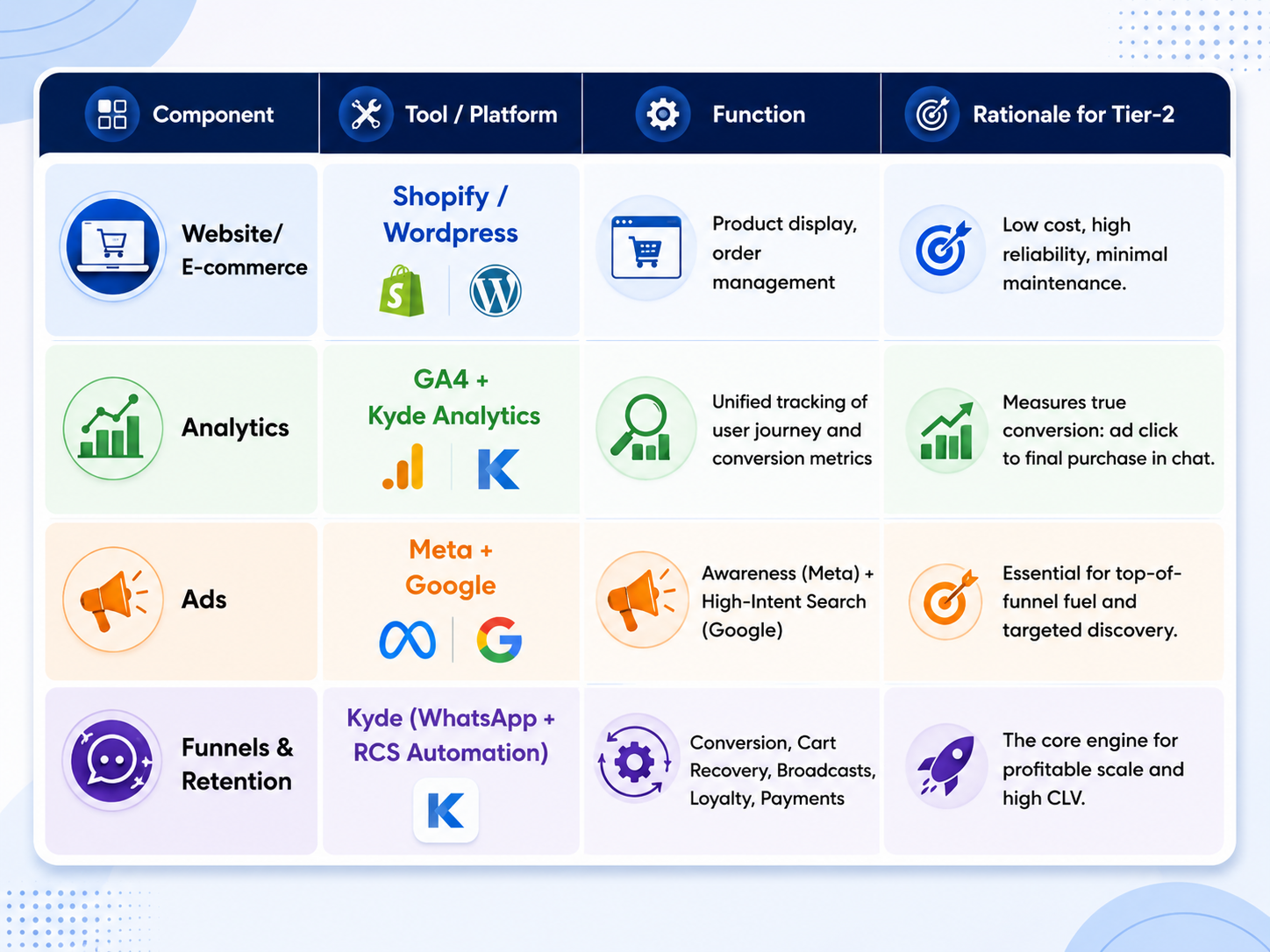
Toolkit for D2C Founders: The High-Efficiency Stack
To execute this blueprint, your technology stack must be minimal, affordable, and focused on integration:
FAQs: Kyde and Conversational Commerce
Q. Why is WhatsApp marketing more effective than email for D2C brands in India?
A: The difference is attention. Indian users treat WhatsApp as their primary inbox, leading to open rates greater than 90%, compared to email’s average of 20%. Furthermore, WhatsApp allows for instant two-way conversation, rich media, and in-chat payments, making the conversion path faster and more personal than the traditional email-to-website journey.
Q. How is Kyde different from the basic WhatsApp Business App?
A: Kyde is built on the official WhatsApp Business API and also integrates RCS (Rich Communication Services). The basic WhatsApp Business app is manual and unscalable. Kyde provides full automation, multi-step conversational funnels, segmentation, bulk broadcasts to thousands of users, in-chat payments, and deep analytics to measure the revenue generated from every message.
Q. What’s the best ad-to-funnel ratio for small D2C brands using Kyde?
A: For lean, retention-focused D2C brands, we recommend shifting resources away from top-of-funnel-only ads. A smart allocation is to spend 60% on ads (Meta/Google) to drive qualified traffic, and 40% on funnel automation and engagement via Kyde. This 40% ensures you maximize the value of the 60% ad spend by achieving repeat purchases, effectively cutting your long-term CAC.
Conclusion: Conversational Funnels are the New Unicorn Strategy
The fight for D2C market share is no longer a battle of budgets; it is a battle of funnel efficiency and customer intimacy. Tier-2 D2C brands don’t need unicorn funding; they need Kyde-powered conversational funnels that leverage India’s WhatsApp-first consumer behavior.
By integrating personalized, automated chat experiences via Kyde, you cut the high-CAC loop, build a dedicated first-party customer list, and engineer repeat purchase loops that ensure sustainable, profitable growth. The future of D2C is direct, personal, and conversational.
At Digital Triangle, we help D2C founders cut CAC, boost conversions, and build repeat customers with Kyde.
Free Strategy Call
Want us to apply this to your brand?
Book a free 30-min call with our team and get a custom growth plan.
Book Free Call →