15 Proven Social Media Marketing Strategies for Startups in 2026
Harsh
Digital Triangle
Your customer is already on social media. They scroll LinkedIn before breakfast. They watch Reels while commuting. And they ask ChatGPT which startup to buy from before opening any website.
So the question isn't whether social media matters. It clearly does. The question is whether your startup is showing up — or getting buried in the feed.
This guide cuts through the noise. 15 strategies that work, a platform framework to pick the right channels, and a system you can start this week.
Why Social Media Marketing Is Essential for Startups
Social media isn't just for brand visibility anymore. It drives real business outcomes. Here's what it actually does:
• Brand Awareness — One viral LinkedIn post can reach tens of thousands of people. For free. That's not possible through offline channels at an early stage.
• Lead Generation — LinkedIn and Instagram both have native lead capture tools. With the right content, inbound leads come to you.
• Customer Acquisition — The gap between "scrolled past your post" and "bought your product" has never been smaller. Social commerce made that happen.
• Community Building — Build a community and you build a moat. Competitors with bigger budgets can't buy genuine loyalty.
• Customer Support — People complain publicly. Respond fast and you build trust in front of everyone watching — not just the person who complained.
• Investor Visibility — Founders who build in public get noticed. LinkedIn content signals execution capability — not just a pitch deck.
• Founder Branding — A founder's personal content beats a brand page every single time. People follow people, not logos.
• Cost-Effective Marketing — Organic social is the highest-ROI channel for early-stage startups. You need time, not budget, to start.
Challenges Startups Face in Social Media Marketing
These are real. Knowing them prevents nasty surprises later.
• Limited budget — Organic reach is shrinking. Every rupee on ads needs a clear return.
• Small teams — Most founders handle content themselves. That's hard to sustain without a proper system.
• Content consistency — Posting twice a week for six months is much harder than it sounds. A calendar is not optional.
• Algorithm shifts — What worked in Q1 may not work in Q2. Track data or you'll always be chasing.
• AI content flood — Every brand has AI tools now. Standing out means being human, specific, and honest.
• Proving ROI — UTM tracking and CRM integration are non-negotiable if you want to connect social activity to actual revenue.
• Platform saturation — There's more content than ever. Generic posts don't break through. Niche focus does.

Build Your Startup Social Media Marketing Strategy
Strategy before content. Always. Here's the framework Digital Triangle uses with startup clients:
Define Goals
Awareness, leads, community, or sales — each needs a different approach. Don't skip this step because it feels obvious.
Know Your Target Audience
Go past demographics. What platforms does your audience actually use? What frustrates them about your category? What language do they speak online?
Build Customer Personas
Two or three is enough. Document their role, daily pain points, and what would make them stop scrolling on a Tuesday morning.
Choose Content Pillars
Three to five themes your brand will own. Product education, founder insights, industry takes, customer wins, team culture — pick what genuinely fits your brand.
Create a Content Calendar
Plan 30 days ahead. It's not glamorous. But it's the one thing that stops most startups from going quiet for three weeks and losing all momentum.
Define KPIs
Reach, engagement rate, website clicks, leads, and conversions. Review weekly. Adjust based on what data shows — not what you hoped would work.
Choose the Right Social Media Platform
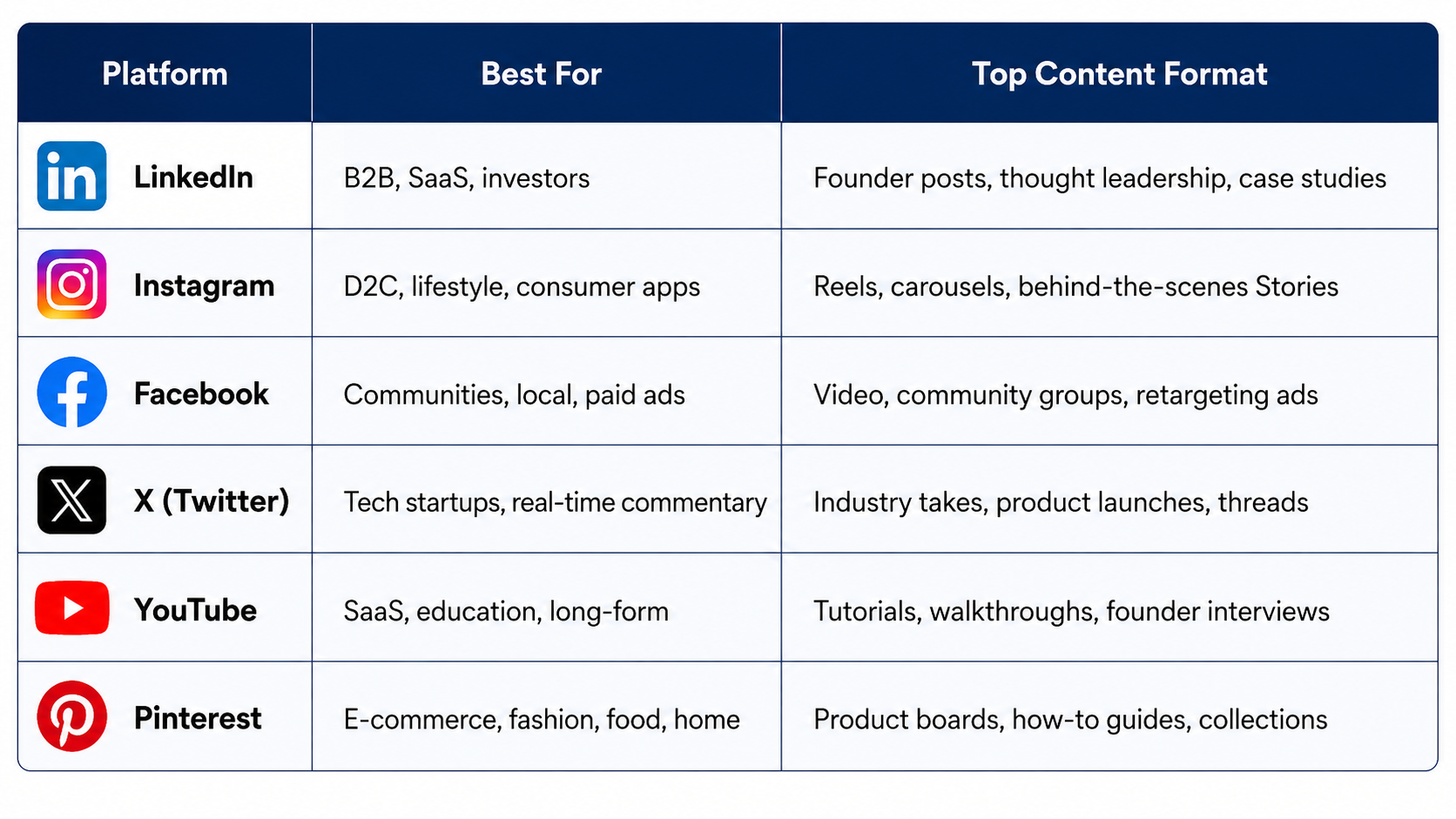
Trying to be everywhere destroys small teams. Pick one or two platforms, dominate them, then expand.
15 Proven Marketing Strategies for Startups
Not theory. These are what Indian startups across B2B, D2C, and SaaS categories are using to grow right now.
• 1. Founder-Led Marketing — Your founder's voice is the most powerful social asset you have. Put it front and centre on LinkedIn. Prioritise it above everything else in the early stages.
• 2. Personal Branding — Build personal brands for your founding team. Opinions, lessons, and honest industry takes — not just product news. Brand equity compounds over time.
• 3. Educational Content — Teach before you sell. How-to content and explainers build the kind of trust that converts. Startups that educate attract buyers who are already convinced.
• 4. Short-Form Video — Reels, YouTube Shorts, LinkedIn video. Highest-reach organic formats in 2026. No big budget needed. Just consistency.
• 5. User-Generated Content — Your customers' content is more believable than anything you produce. Ask for it. Feature it. Make UGC your front-line social proof.
• 6. Community Building — Build on WhatsApp, Slack, or LinkedIn Groups. A community gives you direct, algorithm-free access to your most engaged customers.
• 7. Employee Advocacy — Your team's combined network is bigger than your brand page's following. Give them content to share. It amplifies reach without ad spend.
• 8. Micro-Influencer Marketing — 10,000 to 100,000 followers in your niche. Higher engagement, lower cost, more trust than mega-influencers — and far more suitable for early-stage brands.
• 9. Social Proof — Collect reviews, testimonials, and case study highlights. Share them every week. Social proof is the primary trust signal that moves a lead toward a purchase.
• 10. Social Commerce — Instagram Shops, Facebook Shops, LinkedIn Lead Gen Forms, WhatsApp Business catalogues. Set them up. Every extra click to buy is a sale you might lose.
• 11. AI Content Creation — Use AI to produce more without hiring more. First drafts, caption variants, repurposed posts — AI handles volume, you handle quality control.
• 12. SEO + Social Integration — Your blogs and social content should work together. Blog posts feed social. Social drives traffic back to blogs. Brands doing both win more visibility in 2026.
• 13. Paid Retargeting — Organic builds awareness. Retargeting closes the gap. Use Meta and LinkedIn ads to re-engage people who've already shown interest but haven't bought yet.
• 14. Customer Success Stories — A real result, in a real customer's words, beats every ad or landing page. Get specific with the numbers. Vague testimonials don't convert.
• 15. Data-Driven Optimisation — Check analytics every single week. What's earning reach? What's converting? Double down on what works. Test one variable at a time. That's all strategy is.
Marketing Ideas for Startups
Need content for next week? These formats consistently perform for early-stage and growth-stage startups:
Product demos. Founder stories. Customer testimonials. Industry tips. Behind-the-scenes posts. Live Q&As. Polls. Niche memes. FAQ posts. Product launch teasers. Company culture content. Startup journey updates.
Pick two formats you can actually sustain. That beats twelve formats posted once and abandoned.
Social Media Content Strategy
Having ideas isn't a strategy. Here's what makes one:
• Content Pillars — Every post should serve one of your three to five themes. Pillars make your feed coherent and your brand easier to follow.
• The 80/20 Rule — 80% value-first content. 20% promotional. Brands that only sell get unfollowed. Fast.
• Content Mix — Written posts, short-form video, carousels, Stories. Don't rely on one format. Different formats reach different people.
• Posting Frequency — Three to five times a week per platform. Six consistent months beats six weeks of intensity every single time.
• Repurposing — One blog post should become at least five social assets. More output without more work.
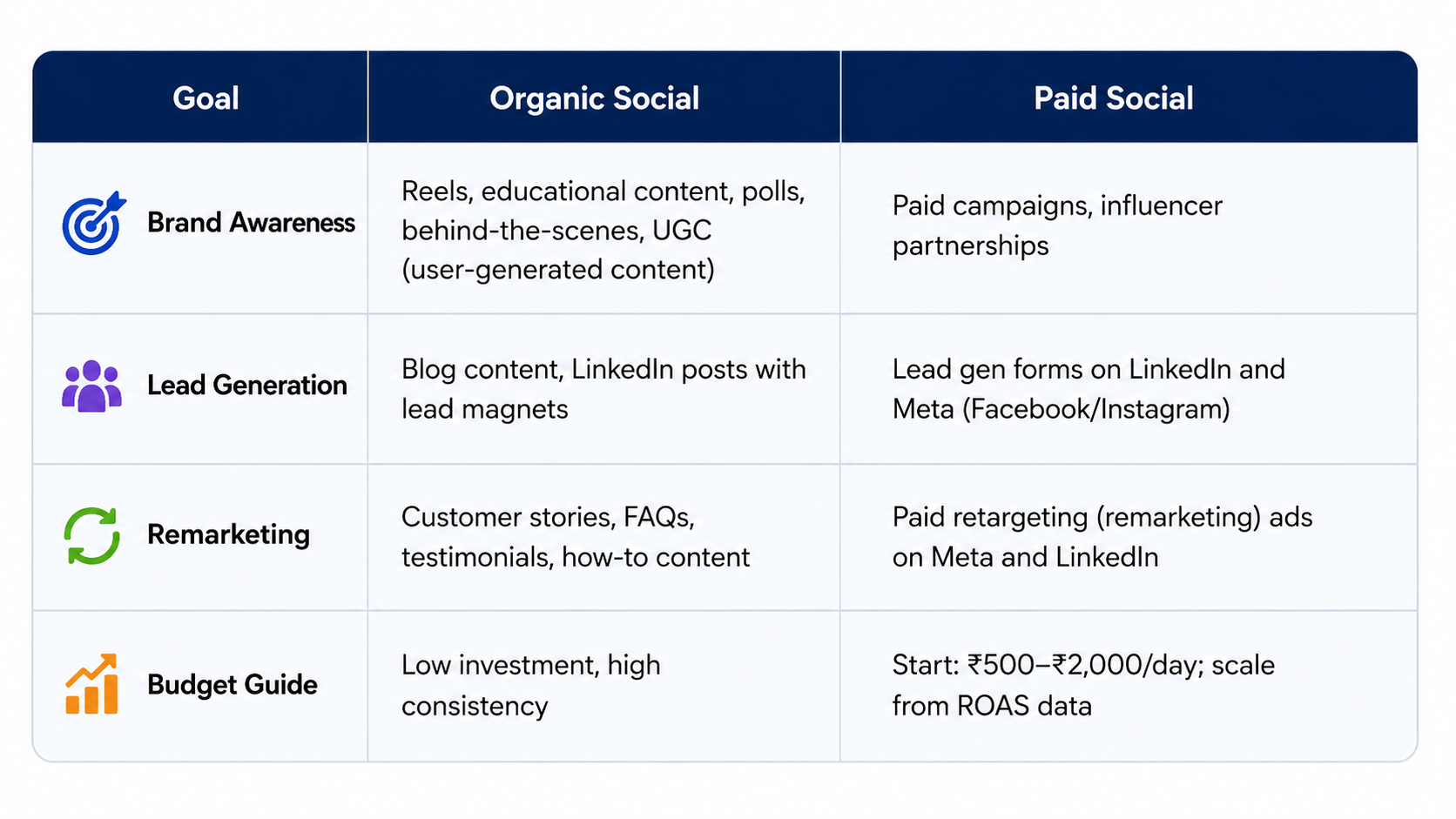
Organic vs Paid Social Media — What to Prioritise
Both have a role. The question is when and how much to invest in each.
AI-Powered Social Media Marketing for Startups
AI is widening the gap between startups. Fast.
Teams using AI right now are producing more content, at a higher standard, than they could with double the headcount. At Digital Triangle, AI sits inside every workflow we build for startup clients.
• AI Captions — Multiple variants tested in seconds instead of hours
• AI Creatives — Canva AI, Firefly, Midjourney for on-brand visuals — no design team needed
• AI Videos — Blog posts converted into short-form video content without editing expertise
• AI Scheduling — Posts published at peak times, automatically
• AI Analytics — Surfaces what's driving real outcomes — not just vanity metrics
• AI Chatbots — Instagram DMs and WhatsApp handled 24/7 without adding headcount
• AI Repurposing — One piece of long-form content becomes ten social posts in minutes
Not using AI in your content workflow yet? You're paying more and producing less.
Social Media Strategy by Startup Stage
Pre-Launch — Build Before You Have Anything to Sell
Post teasers. Build a waitlist. Share the founder's story. Start conversations early. The audience you build before launch is the one that buys on day one.
Launch — Create Momentum
Coordinate your reveal across all platforms the same day. Activate micro-influencer partnerships. Share early customer reactions in real time. Don't go quiet after launch day.
Growth — Scale What Works
Build and activate your community. Run paid campaigns for leads and conversions. Launch referral programmes through social content. Double down on the platforms and formats already generating results.
Scale — Build Category Authority
Invest in founder personal branding. Develop thought leadership. Use your social data to inform product decisions — not just marketing campaigns. This is where you move from growth to leadership.
Key Social Media Metrics to Track
Don't track everything. Track what connects to business outcomes.
• Reach and Impressions — Baseline awareness metric. Are people seeing your content?
• Engagement Rate — Above 3% means you're resonating. Below 1% means something needs fixing.
• CTR — Low click-through on high reach signals a weak offer or a CTA that isn't compelling.
• Conversion Rate — This connects social activity to actual revenue. It's the one that matters most.
• CPL and CAC — Essential once paid campaigns are running. Track by platform, campaign, and creative.
• ROAS — Below 2x on a direct-response campaign? Fix the creative or the targeting before scaling spend.
Common Startup Social Media Mistakes
• Posting without a clear goal attached to each piece of content
• Never reviewing analytics — data is the only honest feedback you'll get
• Buying followers — ruins your engagement rate and signals inauthenticity to investors
• Running six platforms at once with a team of two — quality collapses everywhere
• No brand voice — generic content gets scrolled past, not engaged with
• Over-promotional content — the 80/20 rule exists because audiences tune out brands that only sell
• Going quiet for two weeks, then posting five times — algorithms penalise the gaps
Best Tools for Startup Social Media Marketing
ChatGPT and Claude for content and strategy. Canva for design. CapCut for short-form video. Buffer or Hootsuite for scheduling. Meta Business Suite for Facebook and Instagram management. GA4 for traffic and conversion tracking. Ahrefs for keyword research and content gaps. Notion for planning and team workflow.
How Digital Triangle Helps Startups Grow
Most startup founders try to build a social media presence while running the business at the same time. Something always slips. It's almost always the content.
Digital Triangle — Kyde Digital's specialist growth team — builds the full system. Not a template. Not a calendar with a handshake. An actual end-to-end growth operation: strategy, content, AI workflows, distribution, and weekly reporting.
Our startup services include:
• Startup SEO and AI SEO
• Social Media Marketing — end-to-end strategy and execution
• Content Strategy and repurposing systems
• Personal Branding for founders and leadership teams
• Performance Marketing on Meta and Google
• AI Marketing workflows and automation
• Startup Growth Consulting
• Analytics and Reporting — weekly dashboards tied to business outcomes
If social media isn't generating leads, visibility, or community for your startup — it's a strategy problem. Not a content problem. Contact Digital Triangle today for a customised social media growth strategy built for your stage and goals.
Frequently Asked Questions
What is the best social media marketing strategy for startups?
Start with founder-led content on one platform. Build a 30-day calendar. Track weekly KPIs. Add channels only once the first one is working.
Which social media platform is best for startups?
B2B and SaaS: LinkedIn. D2C and consumer: Instagram. Older demographics: Facebook. Pick one. Dominate it. Then expand.
How often should startups post on social media?
Three to five times a week. Consistency over six months always beats intensity over six weeks.
How much should a startup spend on social media marketing?
Start organic. When you're ready for paid, begin with ₹15,000–₹30,000 a month. Scale from ROAS data — not from assumption.
Is organic social media enough for startups?
In the early stages, yes. Organic builds community and authority. Add paid once you know what content actually resonates with your audience.
How do startups measure social media ROI?
UTM parameters, GA4, and CRM integration. Track CPL, conversion rate, and CAC. Review weekly against your spend.
What content works best for startup marketing?
Founder stories, honest lessons, short-form video, and real customer outcomes. Authenticity wins over polish every time.
Which AI tools can startups use for social media?
ChatGPT and Claude for writing. Canva AI for design. CapCut for video. Buffer for scheduling. Midjourney for image generation.
How can startups generate leads from LinkedIn?
Post founder content targeting your ICP. Use Lead Gen Forms in paid campaigns. Engage in comments daily. Share real customer results with specific numbers.
Should startups hire a social media marketing agency?
If you can't post consistently or don't have the expertise in-house — yes. The cost of inconsistency is higher than the cost of good agency support.
Free Strategy Call
Want us to apply this to your brand?
Book a free 30-min call with our team and get a custom growth plan.
Book Free Call →