Email Marketing For D2C: Proven Strategies To Drive Sales
Harsh
Digital Triangle
Introduction
Today’s successful D2C brands use email marketing strategies as precision instruments for customer engagement, personalization, and revenue generation. In 2026, the brands pulling ahead are not the ones sending the most emails. They are the ones sending the right email, to the right person, at the moment it is most likely to convert, powered by first-party data, predictive AI, and automation that increasingly runs itself.
This guide serves as your comprehensive roadmap, offering proven advice and advanced knowledge of the best strategies. We will delve deep into how leading brands achieve success beyond traditional methods, focusing on three shifts that matter right now: the move to zero-party, AI-driven personalization; the move to agentic automation; and the tightening rules around deliverability, privacy, and compliance.
Benefits of Email Marketing for D2C Brands
Email marketing is an effective way through which D2C brands can build meaningful relationships with their customers while driving measurable business outcomes. It offers a direct, personalized, and impactful way to connect with the audience and generate sales.
1. Direct Communication:
D2C brands can connect directly with their audience and drive sales without intermediaries. With rising search and social ad inflation, owning first-party customer data is crucial. This direct channel allows you to control the relationship and customer journey without rent-seeking middle platforms, delivering messages that resonate with your audience’s needs.
2. Cost-Efficiency:
Email marketing is far more affordable than traditional advertising channels. Industry benchmarks put email ROI in the 36 to 42 dollars return per dollar spent range, with the retail and consumer goods sector performing toward the top of that range (around 45 dollars per dollar spent). With minimal investment, you can reach a large audience and generate substantial returns.
3. Customer Retention:
Email marketing helps build long-term customer relationships. Personalized newsletters, exclusive offers, and loyalty programs keep your brand top-of-mind and encourage repeat purchases. With acquisition costs climbing across paid channels, a well-built lifecycle program is often a D2C brand's single highest-leverage growth lever.
4. Increased Conversions:
Well-crafted email campaigns can significantly boost conversions and sales. Dynamic recommendations matching user interest and targeted promos encourage immediate buying decisions. Clear calls to action inspire readers to take action, leading to higher customer satisfaction and better conversion rates.
Building an Email List for Email marketing for D2C Brands
Growing an email list requires offering immediate value in exchange for a visitor's contact details. Using opt-in incentives and strategic forms helps turn store traffic into a subscriber base. The biggest shift in 2026 is collecting preferences, intent, and context upfront (zero-party data), which is exactly what AI personalization engines need to work well.
1. Lead Magnets:
Lead magnets are incentives given to potential customers for sharing their email addresses. Offering an exclusive discount, free shipping, early access to new items, or a free guide works well. Preference-led lead magnets like short interactive quizzes (for example, "Find your skin type" or "Build your starter kit") capture email and preference data for later personalization.
2. Pop-ups & Website Forms:
Form placement determines how many visitors convert into subscribers. Place sign-up forms strategically on your site, such as on the home page, product pages, and checkout page. Behavior-triggered exit-intent and scroll-based prompts, post-purchase opt-ins, and progressive profiling capture preferences with each interaction.
3. Incentivized Social Media Campaigns:
Social media helps channel organic traffic into your email database. Share contests and giveaways on social media and ask for an email to get entered. You can also run WhatsApp/SMS-to-email bridges (common in Indian D2C), referral programs, and place QR codes on packaging that direct customers to your sign-up page.
Email Marketing Strategies for D2C Brands
The best-performing D2C email campaigns focus on critical customer moments. Modern email flows use interactive elements like embedded review forms and single-click checkout. Consumers can complete product reviews or select cart options directly inside their inbox without leaving for a browser.
1. Welcome Emails:
A welcome email sequence is great for setting the tone on your customer relationships. Welcome series now branch based on signup preference data. Address your subscribers by name, welcome them to your brand community, share the brand mission, and offer them a discount code or exclusive access to new products.
2. Abandoned Cart Emails:
Recover lost sales with abandoned cart flows. Browse abandonment (triggered on product views without cart adds) is the newer edge. Combine this flow with predictive discounting: AI decides if and how much discount is needed for that specific customer rather than a flat rate. Send the first reminder email within 1 hour of abandonment.
3. Product Launch Emails:
Create excitement and anticipation for new product launches with well-timed email campaigns. Give a series of teaser email messages, hinting at the upcoming product and release date. Use an independent announcement email to detail key features. Personalize the launch sequence by past purchase category to reduce fatigue.
4. Post-purchase emails:
Post-purchase emails capitalize on the customer's excitement after buying. Push complementary products or high-value versions of that product they just purchased. AI-predicted replenishment timing now outperforms generic, fixed-day post-purchase upsells, delivering reminders at the optimal hour.
5. Customer Feedback & Reviews:
Customer reviews provide social proof that drives future purchases. Automated review requests should be sent 7 to 14 days after delivery. Write emails requesting reviews about your website and third-party platforms. You can get excellent feedback and reviews by embedding lightweight photo/video UGC requests.
Personalization in Email Marketing for D2C Brands
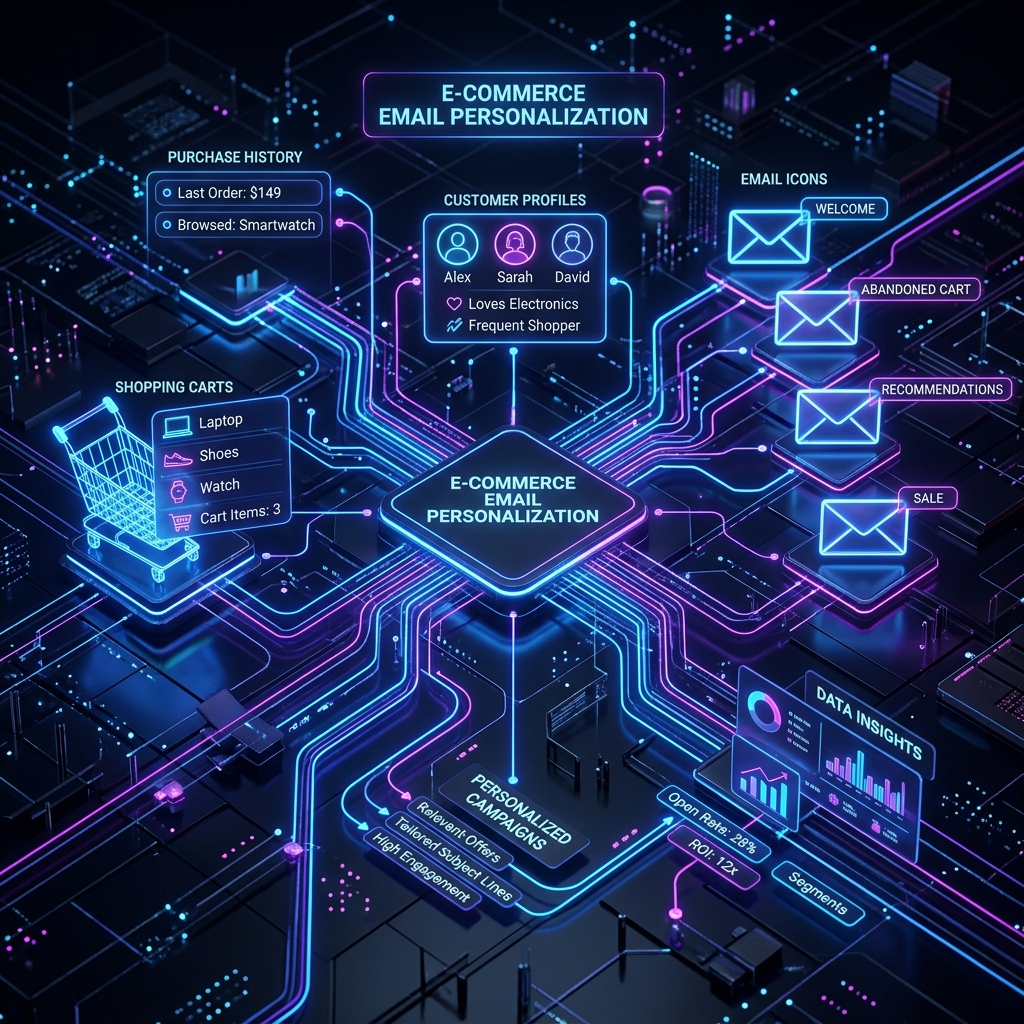
Effective personalization uses customer behavior, browsing history, and purchasing profiles to tailor content. Standard name tags are no longer enough to grab attention in crowded inboxes.
1. Segmentation:
AI-driven segmentation continuously updates audience clusters, replacing static, monthly-refreshed RFM segments. You can group subscribers based on engagement levels (active openers vs. cold subscribers), purchase history (VIP buyers, one-time shoppers, non-buyers), and product interest.
2. Dynamic Content:
Dynamic content changes layout elements based on who is opening the email. Dynamic strategies cover adjusting hero images to match local weather or location, showing product grids matching the recipient's style profile, and updating loyalty point totals in real-time.
3. Personalized Subject Lines:
A well-crafted subject line can make or break your email campaign. You can generate more relevant and engaging subject lines with personalization. Generative tools speed up subject line variants for testing, but a human editorial pass for brand voice and accuracy remains essential before send.
4. Behavioral Triggers:
Behavioral triggers launch emails automatically after specific user actions. High-value triggers cover browsing a product page without adding it to the cart, completing a website quiz, or signing up for a back-in-stock alert. AI engines analyze customer buying frequencies to trigger reminders at the optimal hour.
Email Marketing Automation for D2C Brands
Email automation handles repetitive customer communication tasks automatically based on pre-defined customer events. This system runs in the background, saving time while generating steady sales.
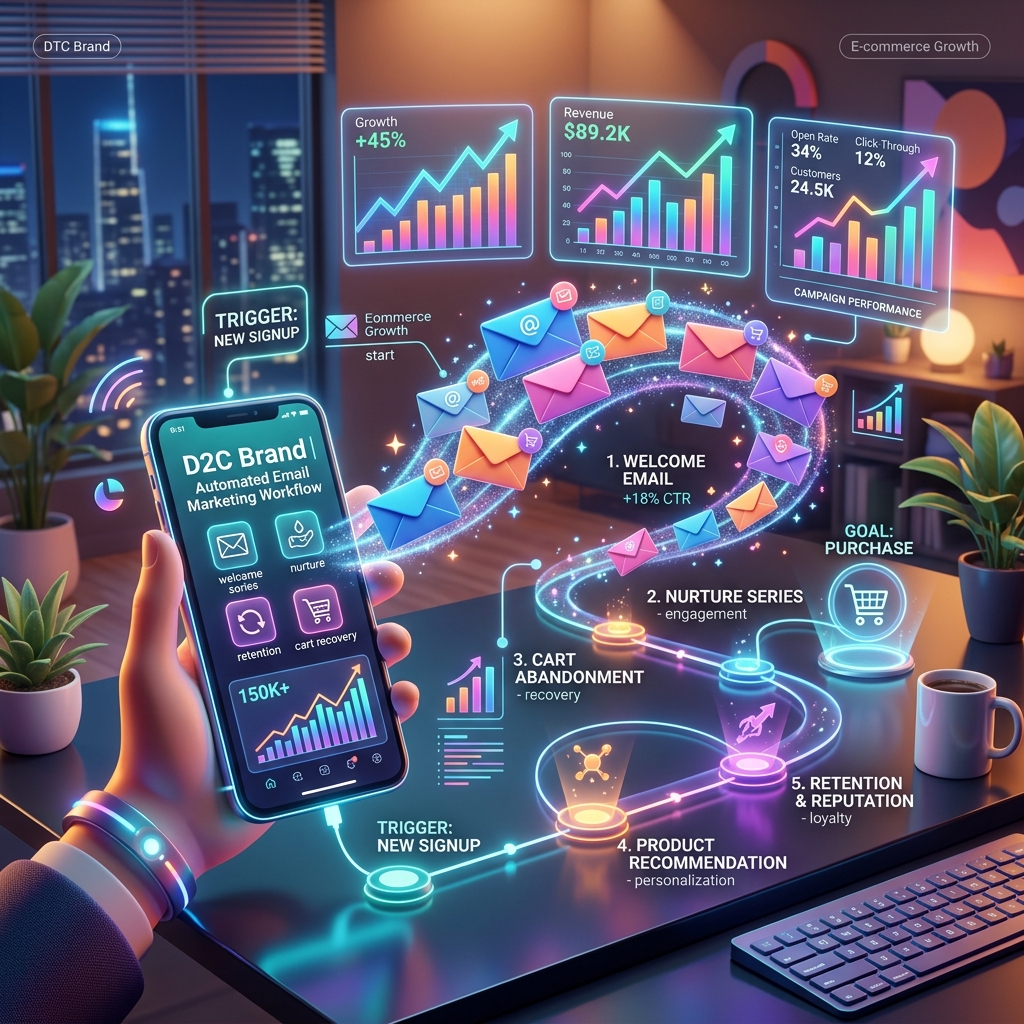
1. Automated Welcome Series:
Automated welcome series run on pre-set schedules to nurture new signups. The workflow typically covers Email 1: Welcome and discount delivery (sent immediately), Email 2: Brand story and social proof (sent 2 days later), and Email 3: Product spotlight and best-sellers (sent 4 days later).
2. Re-engagement Campaigns:
Re-engagement campaigns win back subscribers who have stopped opening emails. Win-back elements cover a direct subject line asking if they still want to hear from you, a special discount to spark renewed interest, and an easy option to update communication preferences.
3. Birthday & Anniversary Emails:
Birthday and anniversary emails build goodwill by celebrating customer milestones. Best practices cover asking for birth dates during signup or in preference centers, sending a gift or discount code on the actual date, and automating the flow to run yearly.
4. Drip Campaigns:
Drip campaigns educate leads over time to prepare them for a purchase. Nurturing steps cover sharing educational guides about product use, addressing common customer concerns, and introducing the team or founders behind the brand.
Best Practices for Email Marketing in D2C
Successful campaigns follow technical deliverability guidelines, clear layout designs, and consumer privacy rules. These checks keep your domain reputation safe and ensure messages reach the inbox.
1. Optimize for Mobile:
Roughly 55% of email opens now happen on mobile. Use single-column designs that prevent horizontal scrolling, large text fonts (at least 14px) for easy reading, and spacious layouts with tappable CTA buttons.
2. A/B Testing:
Split testing isolates variables to find the most effective design elements. Move beyond single-variable A/B tests toward always-on testing of subject lines, send times, and content blocks.
3. Clear CTAs:
A clear call to action tells the reader exactly what to do next. CTA guidelines cover using contrasting button colors that stand out, placing the main button high up in the email, and writing active button text like "Claim Your 20% Off" instead of generic phrases like "Shop Now".
4. Compliance:
Compliance prevents legal penalties and domain blocks. Maintaining deliverability requires strict SPF, DKIM, and DMARC record alignments. Google and Yahoo enforce keeping your spam complaint rate below 0.3% (with optimal recommendations under 0.1%) to prevent domain blacklisting.
India's DPDP Rules 2025 were officially notified in November 2025, but obligations for marketing communications are not enforceable until May 2027. Consent-manager registration opens in November 2026, which is worth monitoring. Build DPDP-ready consent practices now: free, specific, informed, itemized, and easily withdrawable, with no assumption that a past purchase implies marketing consent, rather than waiting for the enforcement date.
Increasing Conversion Rates with Email Marketing for D2C
Boosting conversions requires applying consumer psychology: urgency, specific offers, and social validation. These elements nudge hesitant subscribers toward completing their purchase.
1. Scarcity and Urgency:
Urgency prompts shoppers to take action immediately instead of waiting. Tactics cover running flash sales with clear expiration times, sending low-stock warnings for popular items, and using countdown timers in the email header.
2. Personalization Offers:
Offers work best when they match customer spending habits. Promos cover dynamic, one-time-use codes sized to what it actually takes to convert that customer, mystery gifts added to orders over a specific value, and early access to clearance sales for VIP customers.
3. Strong Calls-to-Action:
Strong CTAs use action-oriented, benefit-driven language. Button copy covers "Claim Your 20% Off" instead of "Shop Now", "Unlock Early Access" to build exclusivity, and "Start My Free Trial" to reduce commitment friction.
4. Social Proof:
Social proof reduces buying anxiety and builds credibility. Trust-builders cover customer reviews placed directly below product grids, press quotes highlighting brand reliability, and user-generated photos showing the product in use.
Conclusion
Email marketing for D2C is one of the most effective tools for communicating with your audience, pushing sales, and creating loyal customers. Remember that email marketing for D2C is not an activity that is done once: it is something you continually plan, execute, and analyze.
Ready to take your email marketing for D2C to the next level? Reach out to see how Digital Triangle can help you build an AI-ready, high-converting email strategy, or subscribe to our newsletter for more insights.
Frequently Asked Questions
What is the best email marketing strategy for D2C brands in 2026?
The most effective 2026 approach combines zero-party data collection (preferences gathered directly from customers), AI-driven lifecycle automation (welcome, abandoned cart, browse abandonment, post-purchase, win-back), and predictive personalization (send-time optimization and dynamic content), layered on top of strict deliverability compliance (SPF/DKIM/DMARC authentication and one-click unsubscribe).
What is a good email marketing ROI for D2C brands?
Industry benchmarks place average email marketing ROI between 36 and 42 dollars for every dollar spent, with retail and consumer goods brands often performing toward the higher end of that range.
Do Gmail and Yahoo require email authentication in 2026?
Yes. Bulk senders (5,000+ emails per day) must implement SPF, DKIM, and a DMARC policy with alignment, plus one-click unsubscribe support. Since November 2025, Gmail enforces this with permanent rejections rather than just spam-foldering, and Microsoft applies matching requirements to Outlook/Hotmail addresses.
Is India's DPDP Act currently enforced for marketing emails?
Not yet. The DPDP Rules were notified in November 2025, but the consent and marketing-related obligations become enforceable from May 2027 (a date that could be moved earlier). Businesses are advised to adopt compliant consent practices now rather than wait for the deadline.
What percentage of emails are opened on mobile devices?
Around 55% of email opens occur on mobile devices, making mobile-first, responsive design a baseline requirement rather than an optional best practice.
Free Strategy Call
Want us to apply this to your brand?
Book a free 30-min call with our team and get a custom growth plan.
Book Free Call →