It's 2026. Your customer has already watched three Reels, read two blog posts, and asked ChatGPT for product recommendations — before opening your website.
That's the market you're competing in.
The brands winning right now aren't the ones with the biggest ad budgets. They're the ones with the right content, in the right place, at the right moment. AI search tools now summarise answers for millions of users every day. The old "post on Instagram and hope" strategy is done.
This guide gives you 50 content ideas, grouped by type and purpose. Whether you want more traffic, higher engagement, or direct sales — start here.
Why Content is the Growth Engine of Every E-Commerce Brand
Most e-commerce brands treat content as an afterthought. A blog here. A few Instagram posts there. No real plan.
That's a costly mistake. Here's what content actually does for your brand:
• SEO: Good blog posts and FAQs pull in search traffic every month. For free. Long after you published them.
• AI Visibility: ChatGPT, Perplexity, and Google AI Overviews now summarise answers for users. They only cite brands with solid, structured content. This is AEO and GEO — and most brands aren't doing it yet.
• Social Media: Consistent content keeps you visible. It builds community. It brings people back.
• Email Marketing: Done right, email still delivers the highest ROI of any channel. But it needs good content to work.
• Customer Retention: Customers who learn from you don't leave easily. Educate them and they stay.
• Brand Authority: The brand that teaches becomes the brand people trust. Trusted brands convert better.
• Higher Conversions: Buying guides, comparisons, and demo videos cut the hesitation that kills sales.
Build Your E-Commerce Content Strategy Before Creating Content
Here's a pattern we see often. A store owner decides to get serious about content. They post five things in a week. Then nothing for three weeks. A few more posts. No results. They quit.
The problem isn't effort. It's the missing system. Sort these out before you write a single word.
Know Your Audience
Who's buying from you? What do they worry about before they click "add to cart"? Your content should answer real questions — not ones invented in a team meeting.
Choose Content Pillars
Pick three to five themes your brand will own. Product education, industry trends, customer stories, behind-the-brand content, and sustainability are strong starting points. Stick to them.
Map Content to the Customer Journey
• Awareness: Blog posts, Reels, YouTube videos, SEO content
• Consideration: Comparisons, buying guides, reviews, FAQs
• Decision: Testimonials, case studies, demo videos, UGC
• Retention: Newsletters, tips, exclusive offers for existing customers
Create a Content Calendar
Plan 30 days ahead. That's it. Don't try to map out 12 months before you start. Plan 30 days, publish consistently, review what worked, and plan 30 more.
Define KPIs
Set specific targets for reach, engagement, website traffic, leads, and conversion. Review them weekly. Adjust based on data — not on what you hoped would work.
50 Best Content Ideas for E-Commerce Stores
Here Best Content Ideas for E-Commerce Stores grouped by type so you can find what fits your brand right now.
Educational Content Ideas
Educational content does something ads can't. It builds trust before someone spends a rupee.
• 1. Buying Guides — Walk customers through the decision. Compare options. Make the choice easy.
• 2. Beginner Guides — "How to choose your first [product]" works well for categories where new buyers don't know where to start.
• 3. Product Tutorials — Show them how to use what they bought. Video works best. Keep it short.
• 4. Industry Trends — Write about what's changing in your niche. Back it up with real data — not just opinions.
• 5. FAQs — What does your support team hear every day? Turn those questions into content.
• 6. Glossaries — Define the jargon in your category. Long-tail keywords, credibility, customer education — all in one post.
• 7. Problem-Solving Articles — Start with the pain. Write from the customer's view. Then show the solution.
Product Content Ideas
Your product pages can't do all the heavy lifting. Content helps close the gap.
• 8. Product Videos — A 60-second video of a product in real use outperforms every static image you'll ever post.
• 9. Product Comparisons — "Product A vs Product B" attracts buyers already close to a decision. High intent. High conversion.
• 10. Feature Breakdowns — Technical buyers want detail. Give it to them.
• 11. New Launch Announcements — Don't just drop a product. Build anticipation. Teaser posts. Countdown content. A reveal.
• 12. Product Bundles — Show how your products work together. Increases average order value straight away.
• 13. Best Sellers — What are people actually buying? Share that data. It's social proof wrapped in a post.
• 14. User Manuals as Content — Your instruction guide is already written. Turn it into an SEO-friendly page. Reduce support tickets too.
Social Media Content Ideas
Platform-native content performs. Content designed for a blog and pasted into Instagram rarely does.
• 15. Reels — Still the highest-reach organic format on Instagram and Facebook. If you're not posting Reels, a huge chunk of your audience can't find you.
• 16. Stories — Use them for time-sensitive content. Polls, countdown timers, limited offers. The 24-hour window creates urgency — use it.
• 17. Polls — "Which colour should we launch next?" One question. Zero production cost. Great engagement and useful market data.
• 18. Memes — Category-specific memes your customer immediately gets. That's the target. Generic memes rarely land.
• 19. Behind the Scenes — Your packing room. Your team. Your process. This builds trust in a way polished brand shoots never quite manage.
• 20. Trending Audio — Pairing a product video with trending audio puts your content in front of people who've never heard of you. Worth trying weekly.
• 21. Before & After — This format was built for beauty, lifestyle, home décor, and fitness brands. Transformation content drives saves every time.
• 22. Customer Reviews as Posts — Design your best reviews into graphics. Real words from real customers are your strongest sales tool.
LinkedIn Post Ideas
B2B e-commerce brands and D2C founders leave enormous reach on the table by ignoring LinkedIn. It's not just for job seekers.
• 23. Founder Story — Share the real reason you started. The honest version — not the polished pitch deck version. LinkedIn rewards that.
• 24. Startup Lessons — "What we learned from our first 100 orders" gets read. It always does.
• 25. Industry Insights — Post data-backed takes on your sector. This marks you as someone who actually knows their market.
• 26. Customer Success — Specific outcomes. Real numbers. "Our client achieved X using Y" beats a generic testimonial every time.
• 27. AI Trends — AI content dominates LinkedIn feeds right now. Share your real perspective — not recycled talking points.
• 28. Company Culture — The team. The values. The day-to-day. Customers and future hires are both watching.
• 29. Business Milestones — "We just hit 10,000 orders" posts earn huge reach. They signal growth and build credibility fast.
Content Creation Ideas
What you say matters. How you package it decides who sees it.
• 30. Blog — SEO and AI search visibility both rely on this. Google AI Overviews now cite well-structured long-form content. Your blog isn't optional in 2026.
• 31. Video — YouTube, LinkedIn video, and Instagram Reels reward brands that show up consistently. The camera doesn't need to be expensive.
• 32. Podcast — A slow build, but powerful. Especially for B2B brands building category authority over time.
• 33. Newsletter — Your email list is the one audience no algorithm can take from you.
• 34. Carousel — Saves and shares on Instagram and LinkedIn. Both platforms treat carousels as high-value engagement signals.
• 35. Short-Form Video — 15 to 60 seconds. Mobile-first. Works for product demos, tips, and trend content.
• 36. Infographics — Data made visual. Shareable and great for picking up backlinks from media outlets.
• 37. Interactive Content — Quizzes, calculators, product finders. Engage users and collect first-party data at the same time.
Creative Content Ideas
When everyone's posting product photos, this is how you stand out.
• 38. Interactive Quiz — "Find your perfect skincare routine." "Which laptop is right for you?" These generate leads while delivering something actually useful.
• 39. Product Personality Test — A creative quiz that matches products to customer identity. Works well for lifestyle and fashion brands.
• 40. User Challenges — Create a branded hashtag. Invite customers to join. Let them make the content.
• 41. Behind Manufacturing — Show how your product is made. Transparency is a real edge in a market full of resellers.
• 42. Brand Storytelling — The origin. The problem you set out to solve. Tell it in long form, then cut it into short versions for every platform.
• 43. Meet the Team — Individual spotlights on your people. Customers buy from brands they feel like they know.
• 44. Myth vs Fact — Pick the three biggest myths in your category and take them apart. Health, tech, food, and fitness brands should do this regularly.
Unique Content Ideas
These formats are rare. That's exactly why they work.
• 45. Sustainability Journey — Document your environmental commitments seriously. Purpose-driven buyers are paying close attention.
• 46. Customer Success Stories — Narrative case studies in your customer's own words. These convert better than almost anything else you'll create.
• 47. Product Evolution — Show version 1 versus version 3. Demonstrates real improvement and builds confidence in your brand.
• 48. Behind Packaging — Show the unboxing experience being developed. D2C packaging content goes viral more than most brands realise.
• 49. Founder Interviews — Honest conversations about the journey. Great for LinkedIn organic reach.
• 50. Community Initiatives — What does your brand do beyond selling? In 2026, that question matters to buyers more than it ever has.
Content Ideas by Platform
Different platforms need different approaches. Copy-pasting the same post everywhere just gives you poor results everywhere.
• Instagram: Reels, carousels, Stories, UGC reposts, influencer partnerships
• Facebook: Video ads, community groups, event content, retargeting posts
• LinkedIn: Founder content, thought leadership, B2B case studies, industry data
• Pinterest: Product photography, lifestyle boards, seasonal guides, how-to pins
• YouTube: Tutorials, reviews, unboxings, long-form brand content
• WhatsApp: Broadcast lists, exclusive offers, order updates, loyalty content
• Email: Newsletters, abandoned cart flows, seasonal campaigns, loyalty rewards
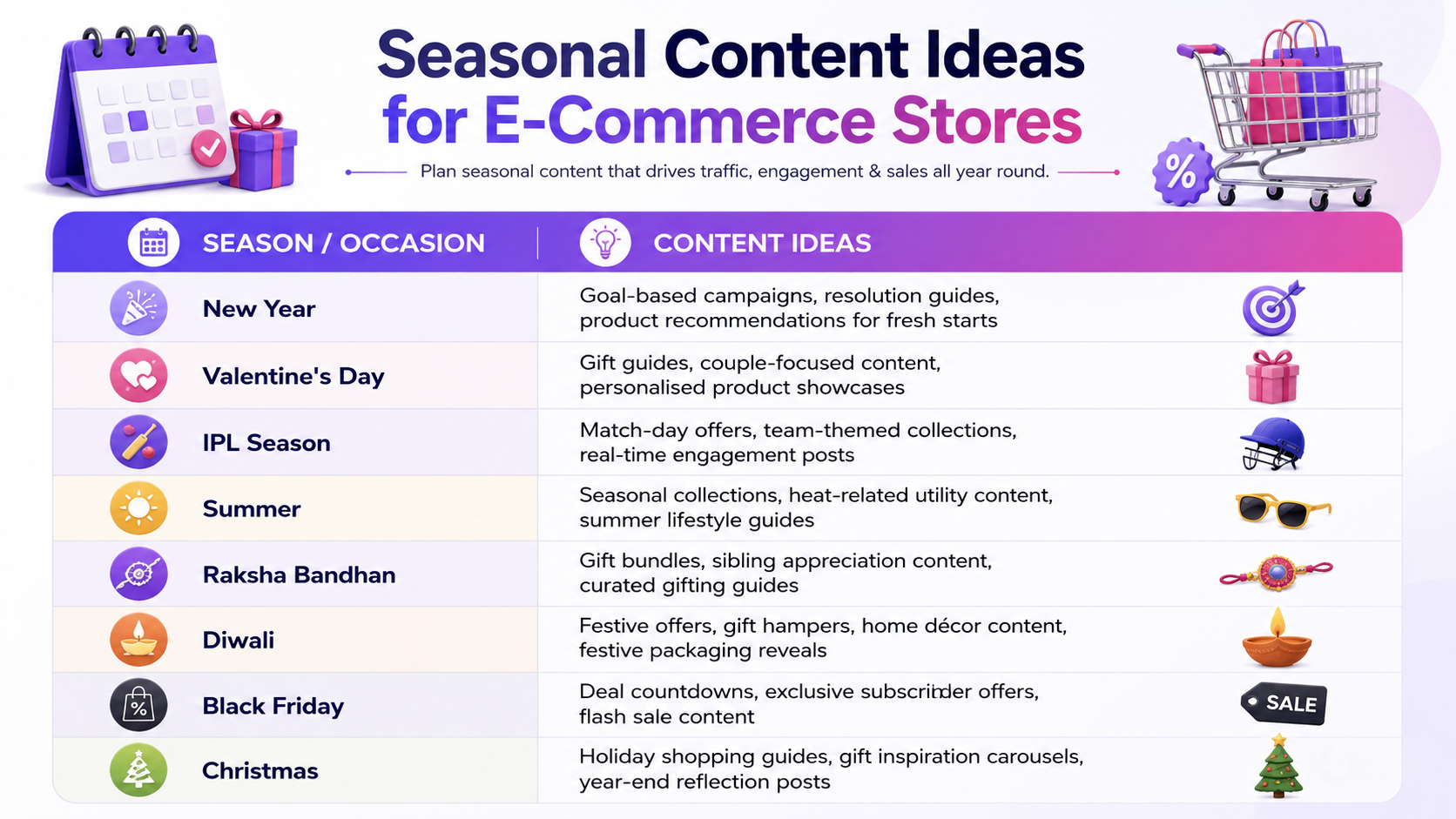
Seasonal Content Ideas for E-Commerce Brands
India's festive calendar is one of the biggest content advantages Indian brands have. Use it well — build around the emotion, not just the offer.
AI-Powered Content Ideas for 2026
This is where the gap between brands is widening fast.
Brands using AI in their content workflow aren't just saving hours. They're producing more content, at a higher quality, than teams three times their size. At Digital Triangle, AI sits inside every content system we build for clients.
Here's what that looks like in practice:
• AI Product Descriptions — SEO-optimized copy, at scale, without losing brand voice
• AI Social Media Captions — Multiple variants generated in seconds, then tested properly
• AI Blog Writing — Solid first drafts built fast, then refined by a human editor
• AI Video Scripts — Reel narrations, YouTube explainers, and ad scripts — aligned to your content calendar
• AI Email Campaigns — Subject lines and body copy personalized by customer behavior
• AI Keyword Research — High-opportunity, low-competition keywords found faster than any manual process
• AI Image Generation — On-brand lifestyle imagery created without an expensive photo shoot
• AI Personalisation — Different content served to different segments, automatically
If your team isn't using AI yet, you're doing the same work at a much higher cost.
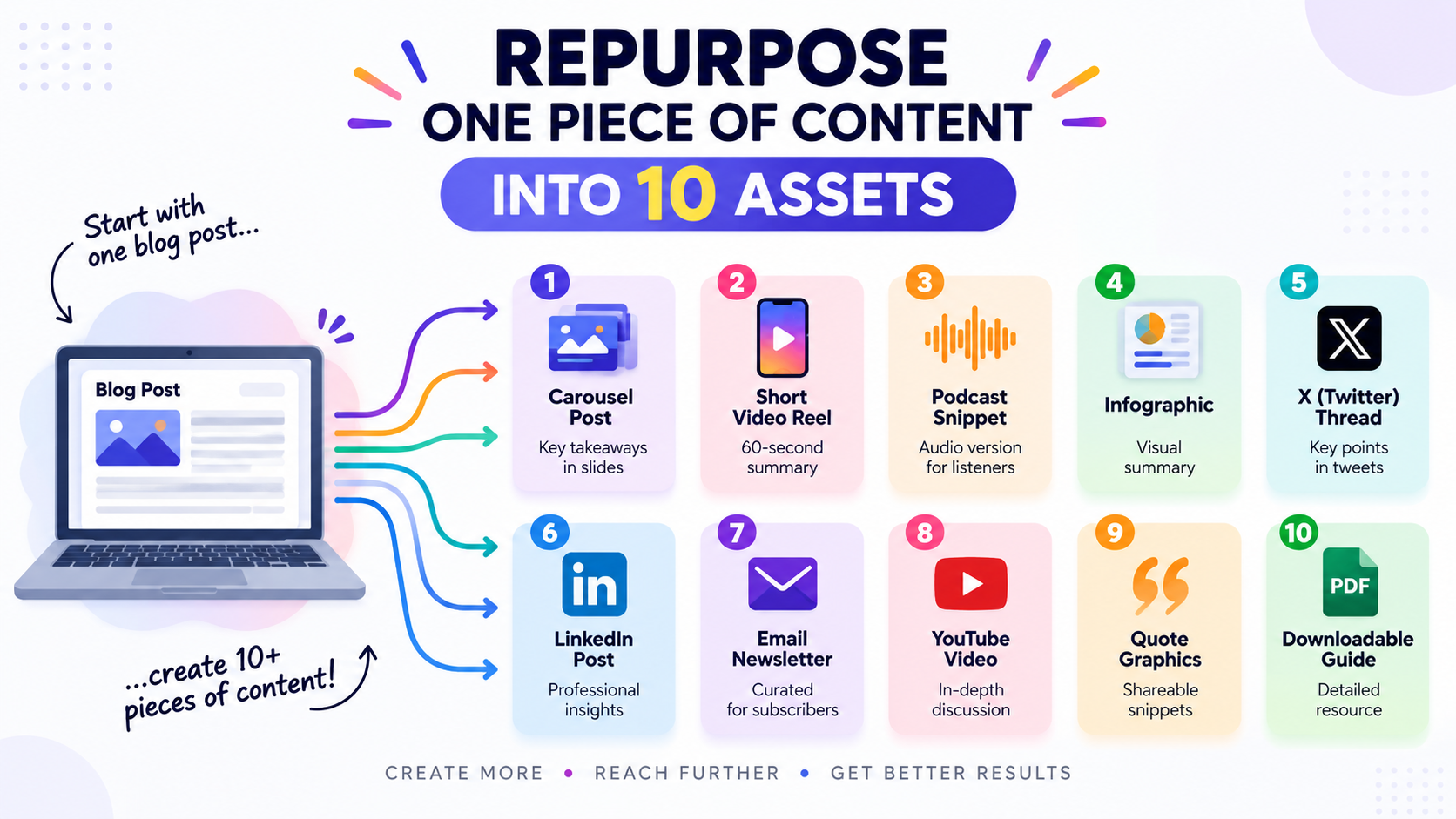
Repurpose One Piece of Content into 10 Assets
One blog. Ten pieces of content. That's the math.
Stop treating content like an endless production line. Create once and distribute everywhere. Here's how it works:
Blog Post →
• LinkedIn long-form article
• Instagram Reel — the key idea, in 30 seconds
• Facebook discussion post
• Pinterest pin with summary
• Email newsletter excerpt with CTA
• Short video explainer
• Infographic
• Carousel (key points as slides)
• Threads post
• YouTube Short
One piece of solid, well-researched content. Ten touchpoints. Same audience, different platforms. Your workload stays manageable.
Content Ideas That Directly Increase Sales
Not every piece of content converts. These formats do.
The reason they work is simple — they cut uncertainty. And uncertainty is why buyers walk away from full carts.
• Buying Guides — Guide the decision. Remove confusion about which product fits which need.
• Product Comparisons — These attract buyers already close to purchasing. They just need the final push.
• Customer Stories — Real results, in real words. No ad copy comes close to this.
• FAQs — Every unanswered question is a potential abandoned cart. Answer all of them.
• Reviews and Ratings — Genuine, detailed reviews built into your content strategy — not treated as an afterthought.
• UGC — Customers trust other customers more than they trust you. Feature their content where buying decisions happen.
• Case Studies — For B2B, a strong case study is often your best-performing content asset. Numbers and specifics win.
Common Content Marketing Mistakes E-Commerce Brands Make
Avoid these. They cost traffic, trust, and sales.
• Only promotional content — If your feed reads like an ad, people treat it like one. They scroll past.
• No SEO — Great content with no keyword strategy is invisible content.
• No keyword research — You're writing answers to questions nobody asked.
• Ignoring AI Search — Content not structured for AEO and GEO is missing a growing share of discovery traffic.
• No CTA — Every piece of content needs a next step. Without one, traffic doesn't convert.
• No internal linking — You're leaving SEO value on the table every time a post goes live without internal links.
• No analytics — If you're not measuring, you're not improving.
Best AI & Marketing Tools for E-Commerce Content Teams
Use these. They're the right ones.
• ChatGPT & Claude — Ideation, drafting, research, and strategy at scale
• Canva — Social posts, carousels, infographics, and branded templates
• Ahrefs / SEMrush — Keyword research and content gap analysis
• Google Trends — Find seasonal opportunities before they peak
• Google Search Console — Track what's actually working in search
• GA4 — Performance tracking and conversion attribution
• Notion — Content planning and team workflow
• Buffer — Scheduling and channel-level analytics
How Digital Triangle Helps E-Commerce Brands Scale
Running an e-commerce brand while building a content engine is genuinely hard. Most teams try it alone, run out of bandwidth, publish inconsistently for months, and give up.
Digital Triangle — Kyde Digital's specialist growth team — is built to fix exactly that.
We don't hand over a content calendar and walk away. We build the full system: strategy, creation, AI workflows, distribution, and weekly performance tracking. A content operation that compounds over time.
Our e-commerce growth services:
• E-Commerce SEO & AI SEO — Rankings that drive traffic which doesn't disappear when you stop paying for ads
• AEO & GEO Optimisation — Visibility in Google AI Overviews, ChatGPT, and Perplexity answers
• Content Marketing — Strategy, creation, distribution, and tracking — all in one system
• Performance Marketing — Meta and Google campaigns that amplify your best content
• Shopify SEO — Category, product, and technical SEO built for Shopify stores
• Social Media Strategy — Platform-native content that builds community and drives measurable sales
• AI Content Systems — End-to-end AI-powered content workflows with human editorial oversight
• Analytics & CRO — Data-driven decisions that keep improving your content ROI
If your content isn't generating traffic, leads, or revenue — that's a strategy problem. Not a content problem. Contact Digital Triangle today for a tailored content strategy session.
Frequently Asked Questions
What content works best for eCommerce?
Blog posts, product videos, customer reviews, and platform-native social formats consistently come out on top. The right mix depends on your category and where your buyer is in the funnel.
How often should an online store publish blogs?
Four to six well-optimised posts per month is a solid target. A steady cadence for six months always beats a publishing burst and disappearance.
How many blogs should an eCommerce website publish each month?
Start at four. Brands in competitive niches often publish daily. Quality and keyword relevance matter more than raw volume.
Does blogging increase eCommerce sales?
Yes. Blog traffic is high-intent. Posts that rank for buying queries cut pre-purchase doubt and drive conversions — often better than paid ads over the long run.
Which social media platform is best for online stores?
Instagram and Facebook for B2C. LinkedIn for B2B. Pinterest for home décor, fashion, and lifestyle. Go where your specific customer already spends time.
What AI tools help create eCommerce content?
ChatGPT and Claude for writing, Canva AI for design, Ahrefs for research, and Midjourney or Adobe Firefly for images. Together they let a small team punch well above their weight.
How do I create a content calendar?
Start with your pillars. Map them to your product launches and seasonal calendar. Assign formats to platforms. Schedule 30 days ahead. Review. Repeat.
What content improves SEO rankings?
Long-form, structured content built around specific search queries — with internal links, schema markup, and AEO optimisation — consistently outperforms thin or generic content.
How can small businesses create content on a budget?
One blog post per week, repurposed across platforms using Canva and CapCut. Reels and long-form blog content give you the best organic reach for the least cost.
What is the difference between content marketing and social media marketing?
Content marketing is the full strategy. Social media is one distribution channel within it. Strong brands use social media to amplify content they've already built — not as a replacement for it.
Free Strategy Call
Want us to apply this to your brand?
Book a free 30-min call with our team and get a custom growth plan.
Book Free Call →